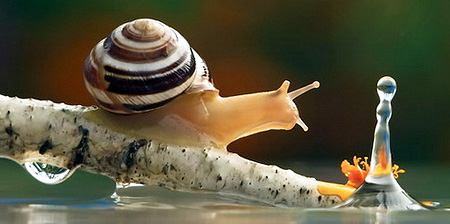
When I was a child, I would crouch in the garden for hours watching snails. To most people they were slow, slimy, forgettable creatures. But to me, they were monks of the soil. Their shells fascinated me—their spirals were perfect diagrams of infinity, coiled galaxies small enough to fit in the palm of my hand. I did not have the language then for sacred geometry or Fibonacci sequence, but I knew in my bones that these creatures carried the same mathematics that shaped sunflowers, storms, and stars.
I remember holding them with breathless patience. If I shifted too much, if I poked or prodded, they would retreat instantly, collapsing into the safety of their spiral fortress. Inside, they were untouchable, but also blind, sealed away from food, movement, and light. Only when I grew still—utterly still—did they begin to emerge. First the soft glisten of their bodies, then the delicate feelers, then at last their tiny faces opening to the world. To hold a snail was to be taught meditation long before I had words for meditation.
Years later, as I sat in silence on a cushion, I realized that the chakras behave in just this way. Each one is a living spiral of subtle energy, a wheel of awareness turning within the body. And like the snail, each chakra longs to extend itself into the world, to touch, to see, to explore. But the moment life becomes too loud, too harsh, too violent, they recoil. A harsh word can send the throat chakra back into hiding. A broken trust can send the heart curling into itself. Fear can send the root deep underground. Protection is their gift, but also their prison. Safe, but sealed.
And yet there is another way. When we come to meditation with stillness, gentleness, and patience, the chakras, like snails, begin to unfurl. Not all at once. Slowly, shyly, with hesitation, but also with wonder. The root extends first, testing the ground. Then the sacral chakra glides out, tasting the sweetness of water and connection. The solar plexus emerges with courage, discovering that power is not domination but light. The heart opens, and its radiance is like the rainbow trail of the snail, leaving behind a subtle blessing of compassion wherever it moves. The upper chakras reach out like antennae into subtler realms: the throat, expressing the truth; the third eye, perceiving the invisible; the crown, spiraling into infinity itself.
This is why forcing never works. We cannot pry open a snail. We cannot wrench a flower to bloom. And we cannot crack open the chakras with pride or ambition. They open only in the presence of stillness, safety, and trust. In that quiet, what was once hidden awakens. What was once closed begins to see, to feel, to explore.
The snail teaches us that even the smallest, slowest movement leaves behind a rainbow. Every journey, no matter how humble, becomes a trail of light. In the same way, every moment of presence we bring to the world leaves behind its own iridescence—sometimes invisible to us, but shining quietly for those who come after.
So let us learn the dharma from these small monks of the garden. Carry the monastery of your soul upon your back, but do not live sealed inside it. Trust the spiral. Trust the stillness that coaxes life outward. Move slowly, yes, but move. Allow your chakras, your inner snails, to venture forth. And as they do, you will find that the entire cosmos unfurls within you—petal by petal, spiral by spiral, face by tender face.
The teaching is simple, but inexhaustible: the world reveals itself when we are still enough to let it. And when we are still enough, the rainbow path appears beneath our very steps.
Guided Meditation
Meditation is the art of becoming still enough, tender enough, and patient enough for these subtle snails to emerge. It is not about prying open the petals of the chakras, but about creating the silence where they feel safe to unfurl. What follows is a visualization—a way to sit quietly and invite these spirals of light to reveal themselves, one by one.
Begin by sitting comfortably, spine upright, as though your own body is the great staff of a snail’s shell. Feel the weight of your body resting on the earth. Like the snail, you carry your home with you. Like the snail, you are already whole. Breathe gently. Wait without expectation.
Now bring your awareness to the base of the spine. Imagine a snail tucked into its spiral shell. At first, nothing moves. Simply wait. Offer stillness. With time, you may sense the root chakra beginning to extend—like the snail’s first feelers tasting the earth. It whispers, I am safe, I belong here. Breathe, and let it unfold.
Move now to the lower belly, the sacral chakra. Another snail rests here, coiled in its luminous shell. Do not force it. Simply sit with it. In patience, it too begins to glide forward, tasting the waters of life, whispering, I feel, I flow, I create. See it leaving a trail of silver light, like the snail’s rainbow path, painting beauty upon the world.
At the solar plexus, just above the navel, rests another spiral. This snail emerges with courage. It teaches you that power is not domination but radiance. Feel its body shimmering golden as it whispers, I shine, I act, I am strong. Like the sun warming the garden, this chakra brings warmth to the path.
In the heart, the snail is especially tender. It retreats easily, but when stillness surrounds it, it opens with astonishing beauty. As it extends, its trail is not silver but iridescent, shimmering with compassion. It whispers, I love, I am loved, I am connected. Feel its rainbow light spiraling outward, leaving traces of kindness wherever you walk.
At the throat, another snail unfurls, stretching delicate antennae toward the horizon. It whispers, I speak, I listen, I express. Its trail is a clear blue stream, flowing in and out, carrying truth like water through the world.
The third eye, at the brow, houses a snail of perception. When it emerges, it does not move outward only—it looks inward and outward at once. It whispers, I see, I understand, I awaken. Its trail glows violet and indigo, revealing the hidden geometries that weave all life together.
Finally, at the crown of the head, the last snail rests within its infinite spiral. When it emerges, it does not crawl but blossoms, spiraling upward into the sky. Its whisper is silence, but in that silence is the wordless mantra, I am, I am infinity. Its trail is the Milky Way itself, a cosmic spiral returning to the source.
Sit with this vision. Seven snails, seven spirals, each one moving gently outward, leaving trails of light. You do not rush them. You do not prod them. You only hold the stillness in which they feel safe to emerge. One by one, they open, and you discover that your whole being is a luminous garden path, painted in rainbow light.
What you seek is already within you, coiled in sacred geometry. What is required is not force but stillness, not hurry but patience, not ambition but presence. Like the snail, you are already carrying the spiral of the cosmos within your very form. All that remains is to wait with enough tenderness for it to emerge.
And as you rise from meditation, remember this: even the smallest, slowest step, taken in trust, leaves behind a trail of light.